Even the best betting strategy fails without proper bankroll management. Losing runs are a certainty, not a possibility, and the size of your stakes decides whether you survive them. This guide explains how to set up a bankroll and choose a staking plan.
Step 1: Define your bankroll
Your bankroll is money set aside only for betting, separate from savings and bills. It should be an amount you can afford to lose completely without it affecting your life. Every stake you place is calculated from this number.
Step 2: Work in units
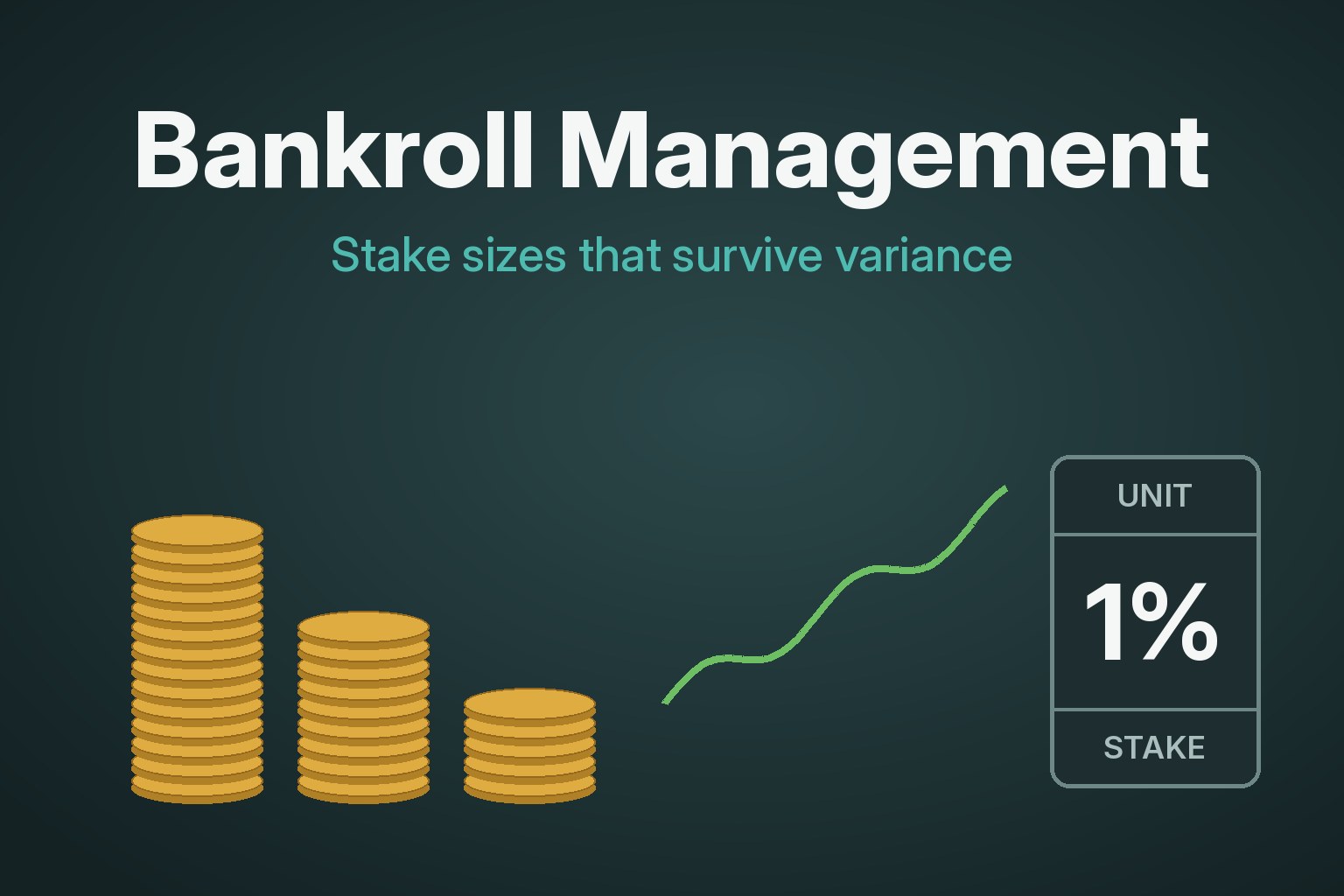
A unit is a fixed percentage of your bankroll, usually between 1% and 2%. With a $1,000 bankroll, 1 unit = $10. Thinking in units keeps stakes consistent and makes it easy to compare results over time, whatever the size of your bankroll.
Step 3: Choose a staking plan
Flat staking: every bet is 1 unit. Simple, disciplined and ideal for most bettors.
Percentage staking: every bet is a fixed percentage of your current bankroll. Stakes grow as you win and shrink as you lose, which protects you during losing runs.
Confidence staking: 1 to 3 units depending on the size of your edge. Only use this if you have a proven record of estimating your edge accurately.
Why small stakes matter
Losing streaks are longer than most people expect. Over 1,000 bets at roughly even odds, a run of nine or ten consecutive losses is normal. Compare what ten straight losses do to different stake sizes:
1% flat stakes: 10 x 1% = a 10% drawdown 5% flat stakes: 10 x 5% = a 50% drawdown 10% percentage stakes: 0.90 to the power of 10 = 0.35, a 65% drawdown
At 1% you shrug it off. At 10% your bankroll is broken, even if your strategy is perfectly sound.
Practical rules
Never chase losses by increasing stakes after a bad day.
Keep a record of every bet: date, market, odds, stake and result.
Review stake sizes monthly, not after every bet.
The limits of bankroll management
Staking plans protect a good strategy but cannot rescue a bad one. If your bets have negative Expected Value, careful staking only slows down the losses. Combine good bankroll management with a method for finding value, such as a Poisson model or line shopping.