Results are a noisy way to judge a betting strategy. A good bettor can lose for months, and a poor one can win for a while through luck. Professional bettors therefore rely on a sharper measure: Closing Line Value (CLV).
What is the closing line?
The closing line is the final price available just before kick-off. By then, the market has absorbed team news, injury updates and the money of the sharpest bettors. That makes the closing price the most accurate public estimate of a team's true chance of winning.
If you consistently get better odds than the closing price, you are consistently beating the most efficient version of the market. Over time, that is very hard to do by luck alone.
How to calculate CLV
The simple version compares your odds with the closing odds:
CLV = (your odds / closing odds) – 1
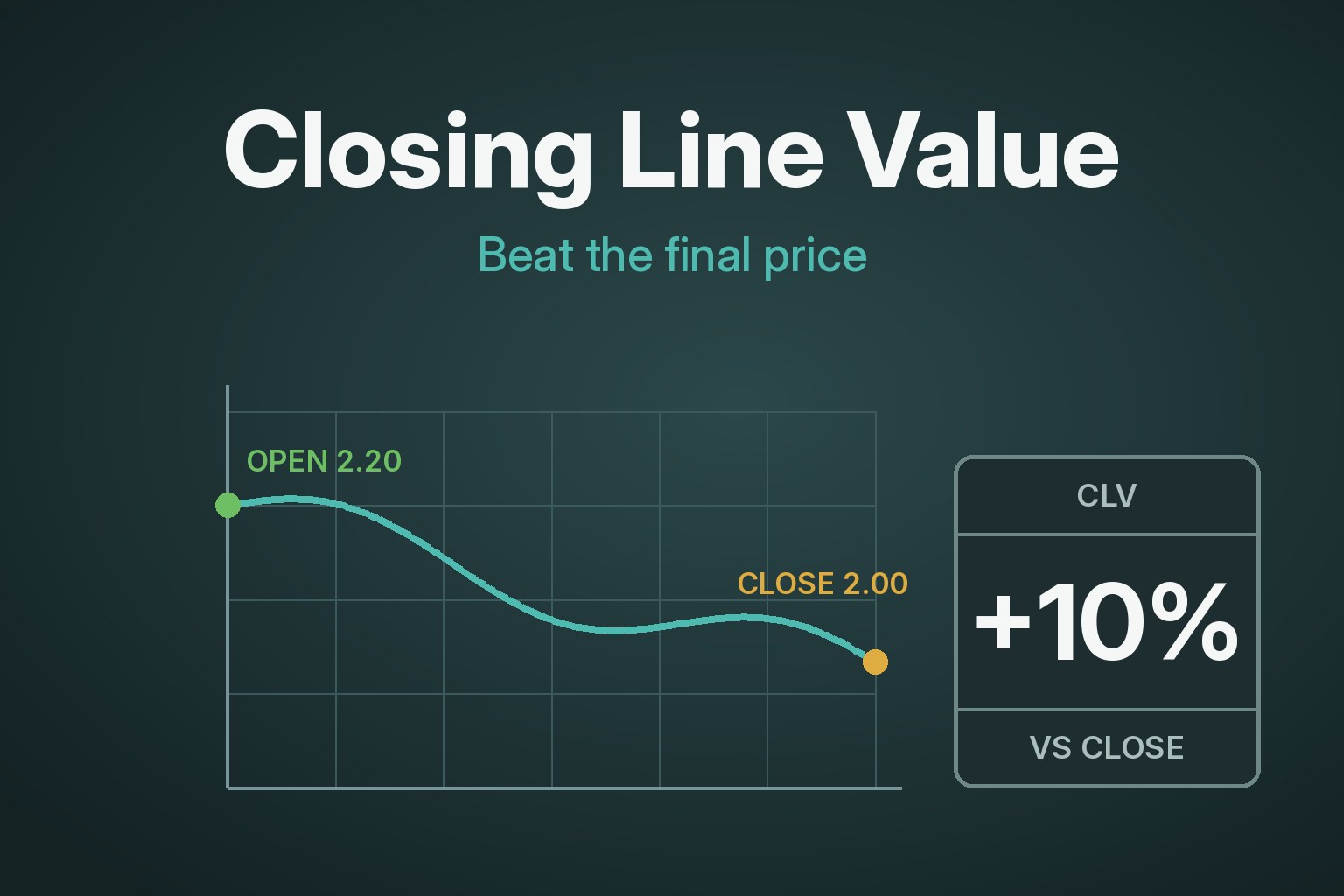
You back a team at 2.20 on Tuesday. By kick-off, the price has fallen to 2.00.
(2.20 / 2.00) – 1 = 10% CLV
The more accurate version
The closing odds still include the bookmaker's margin, so it is better to compare against a fair, margin-free closing price. Suppose the closing two-way market is 2.00 and 1.85:
1 / 2.00 = 50.00% 1 / 1.85 = 54.05% Total = 104.05%
Fair probability of your side: 50.00% / 104.05% = 48.05% Fair closing odds: 1 / 0.4805 = 2.08
(2.20 / 2.08) – 1 = 5.7% CLV
A 5.7% edge over the fair closing price is an excellent result. Low-margin bookmakers such as Pinnacle are commonly used as the reference for closing prices because their lines are the hardest to beat.
Why CLV matters
You need thousands of bets before your profit and loss tells you much about your skill. CLV gives you a reliable signal after a few hundred bets. If your average CLV is positive, your process is sound, even during a losing run. If it is negative, a winning run is most likely luck.
The limits of CLV
CLV assumes the closing price is efficient. In small leagues and niche markets with little money, closing prices can still be wrong, so CLV is a weaker guide there. Also note that beating the closing line does not guarantee short-term profit: it measures the quality of your prices, not the outcome of individual matches.