What is Expected Value? The amount a player can expect to win or lose if they were to place a bet on the same odds many times over, calculated through a simple equation multiplying the probability of winning by the amount you could win per bet, and subtracting the probability of losing multiplied by the amount lost per bet.
A simple example of Expected Value (EV) put into practice — if you were to bet $10 on heads in a coin toss, and you were to receive $11 every time you got it right, the EV would be 0.5.
This means that if you were to make the same bet on heads over and over again, you can expect to win an average of $0.50 for each bet of $10.
How Does Expected Value in Sports Betting Help? Remember, a negative EV doesn’t mean you’re going to lose money. Unlike a coin toss, sports betting odds are subjective, and therefore, if you outsmart the bookmaker, you’re likely to make money.
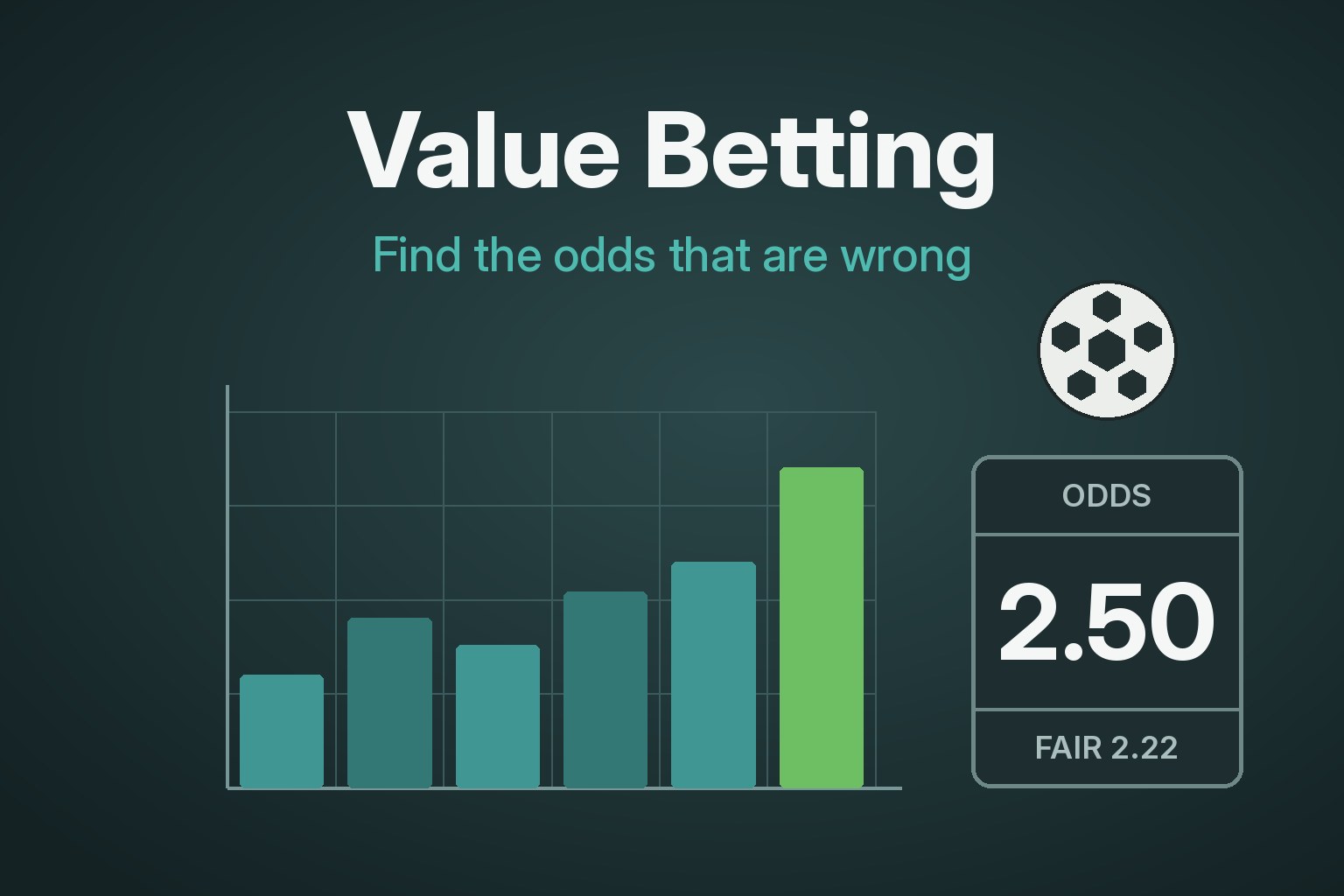
If you calculate your own probability for a match that differs from the implied probability of the odds, you could see where to find a positive EV bet, and therefore the best chance to win.
For example, the odds imply that Nottingham Forest only has an 11.79% chance of winning the match. If you calculate (maybe using a system like Poisson distribution ) that Forest has a 15% chance of winning, the EV for betting on a Forest victory jumps to $2.30.
(0.15 x 72) – (0.85 x 10) = +$2.30
It’s also a perfect measure for comparing odds in arbitrage betting, which you can do using our Arbitrage Calculator .
Calculating the EV of bets gives bettors more information about the value of their bookmaker. While low-margin bookmakers like Pinnacle have EVs of around -$0.20, it’s not uncommon for typical bookmakers to have an EV of -$1.00 — for every $10 stake, you would be likely to lose $1.