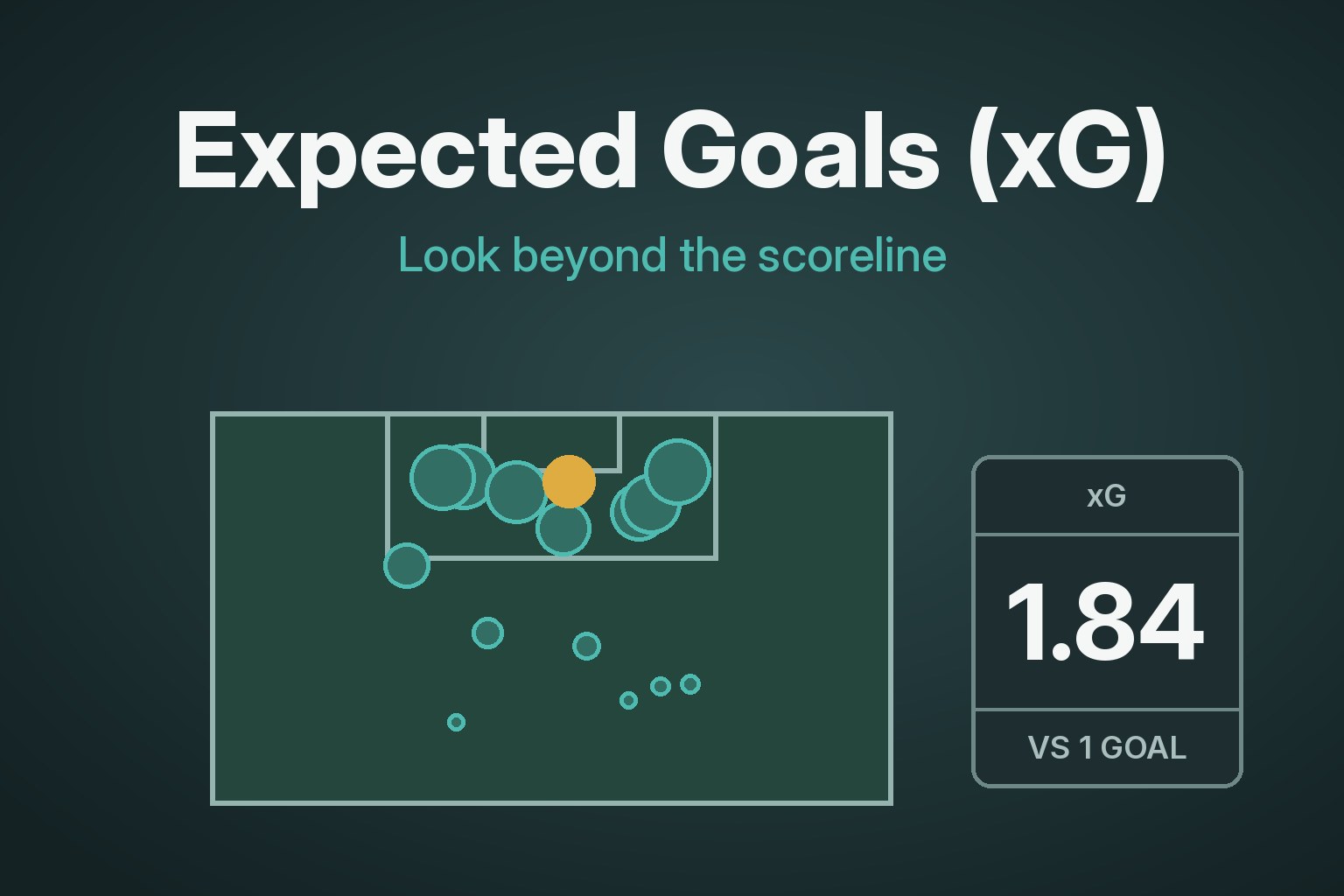
Scorelines can be misleading. A team can win 1-0 after being outplayed for 90 minutes, or lose despite creating the better chances. Expected Goals (xG) measures the quality of chances a team creates and concedes, giving you a clearer picture of true performance than results alone.
What is xG?
Every shot is given a value between 0 and 1, representing the probability that a shot like it results in a goal. The value is based on thousands of historical shots with similar characteristics: distance, angle, type of assist, body part, and whether it came from open play or a set piece.
A penalty is worth about 0.76 xG. A shot from 25 metres might be worth just 0.03. Add up the values of all shots in a match and you get each team's xG.
Why xG matters for betting
Results are heavily influenced by luck in the short term. xG is much more stable, and it is a better predictor of future results than goals scored or points earned. That means it helps you spot teams whose results do not match their performances.
A worked example
Over their last six matches:
Team A has scored 9 goals from 5.2 xG. Team B has scored 4 goals from 8.1 xG.
Team A has been converting chances far above the expected rate, which is usually not sustainable. Team B has been unlucky and is creating plenty of good chances. The market often prices teams on recent results, so Team A may be overrated and Team B underrated. That is exactly the kind of gap value bettors look for.
How to use xG in your analysis
Compare xG for and xG against per match, not just goals.
Use non-penalty xG (npxG) to remove the noise of penalty awards.
Look at a sample of at least 10 matches before drawing conclusions.
Use xG instead of goals as the input for a Poisson model to get more stable predictions.
The limits of xG
Not all xG models are the same. Different data providers can give quite different values for the same match. xG also does not capture finishing quality: elite strikers do outperform their xG over long periods. Finally, game state matters. A team leading 2-0 may deliberately allow low-quality shots, which inflates its opponent's xG without reflecting a real threat.