Lay the Draw is one of the best known football trading strategies on betting exchanges. Instead of betting on a team, you bet against the draw and aim to trade out for a profit as soon as a goal is scored. It is a trading approach rather than a traditional bet, so it is important to understand how the numbers work.
What does "laying" mean?
On a betting exchange, you can act as the bookmaker. When you lay a selection, you win if it does not happen and pay out if it does. Laying the draw means you win if either team wins, and you lose if the match ends level.
How the strategy works
Before kick-off or early in the match, you lay the draw.
If a goal is scored, the draw becomes less likely and its odds rise.
You then back the draw at the higher odds to lock in a profit, whatever the final result.
If no goal is scored, the draw odds fall as time passes, and you may need to exit at a loss.
A worked example
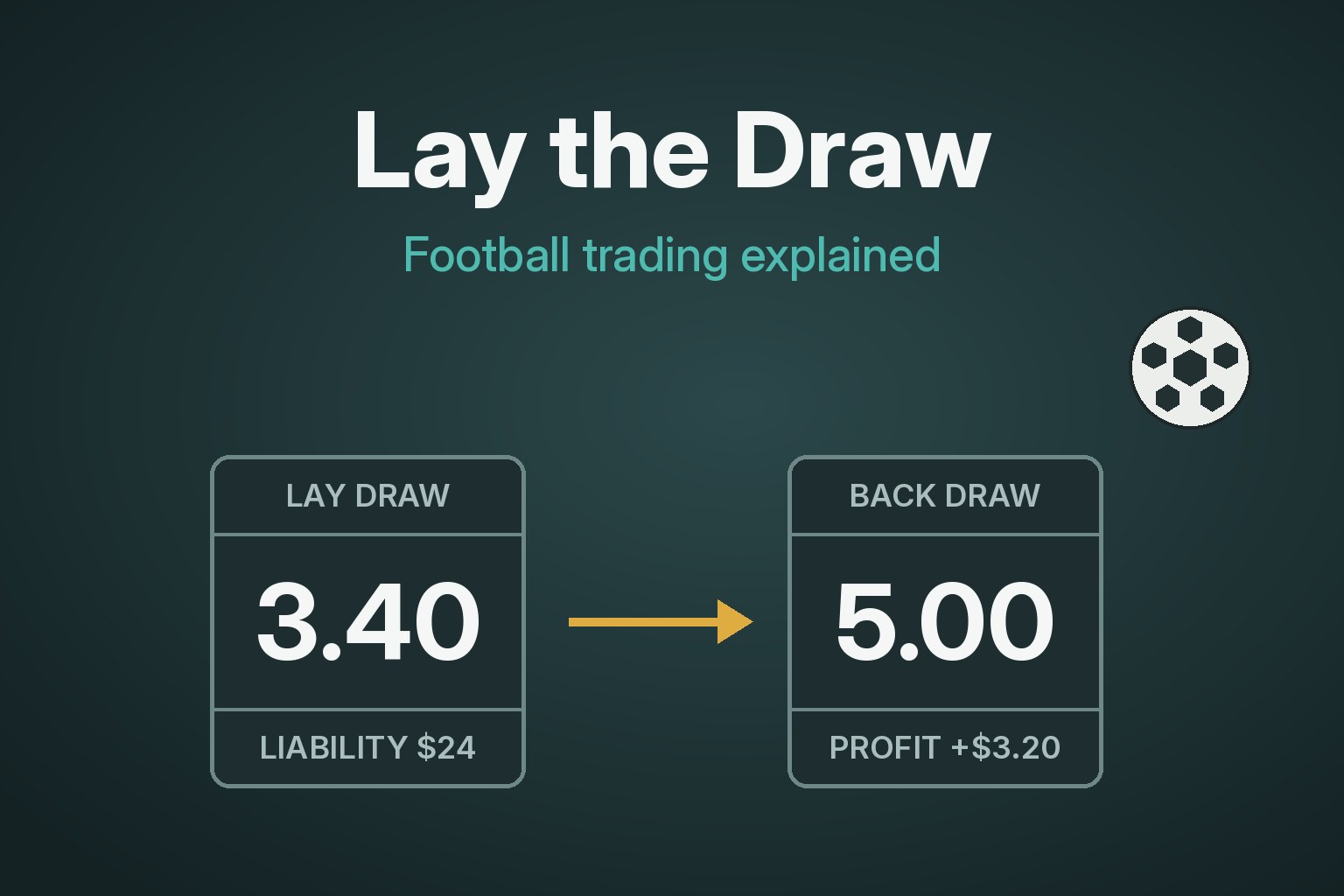
You lay the draw for $10 at odds of 3.40. Your liability is $10 x (3.40 – 1) = $24.
A goal is scored in the 30th minute, and the draw drifts out to 5.00. To lock in an equal profit on every outcome, you back the draw with:
Back stake = lay stake x lay odds / back odds Back stake = $10 x 3.40 / 5.00 = $6.80
If the match ends in a draw: –$24 + ($6.80 x 4.00) = +$3.20 If either team wins: +$10 – $6.80 = +$3.20
You now have a guaranteed $3.20 profit, before exchange commission.
When no goal arrives
Suppose the match is still 0-0 at 75 minutes and the draw has shortened to 2.00. Trading out now:
Back stake = $10 x 3.40 / 2.00 = $17.00 Result on every outcome: –$7.00
Accepting a controlled loss is part of the strategy. Waiting longer in the hope of a goal risks losing the full $24 liability.
Choosing matches
Look for matches with a clear favourite, two attacking teams, and a low historical draw rate. Avoid evenly matched, defensive sides, where the draw is a very realistic result.
The limits of Lay the Draw
Exchange commission, usually between 2% and 5% of net winnings, reduces every profit. Goals can come for the underdog and leave the draw price lower than expected. And the strategy only has long-term value if your match selection is better than the market's prices. Practise with small stakes first and record every trade.