The Over/Under 2.5 goals market asks one question: will the match have three or more goals? It is one of the most liquid football markets in the world, which makes it a great place to apply a statistical model. Here is how to turn expected goals into a fair price.
Step 1: Calculate the total expected goals
Using the Tottenham v Everton example from our Poisson Distribution article:
Tottenham expected goals: 1.623 Everton expected goals: 0.824 Total expected goals: 1.623 + 0.824 = 2.447
A useful property of Poisson is that the total number of goals in the match also follows a Poisson distribution, with an average equal to the sum of both teams' averages.
Step 2: Calculate the chance of 0, 1 and 2 goals
The Poisson formula for exactly k goals is:
P(k) = e^(–2.447) x 2.447^k / k!
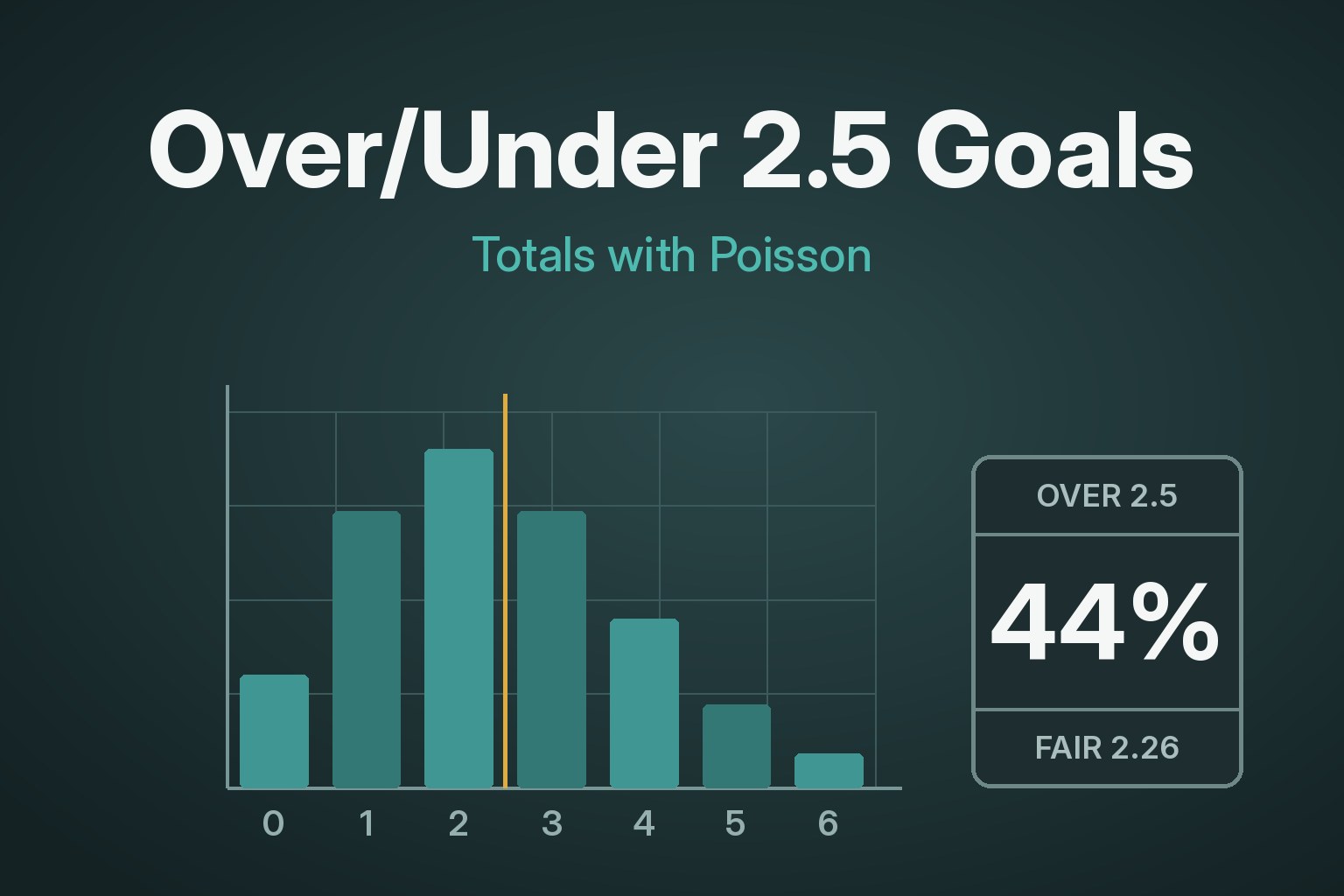
0 goals: 8.65% 1 goal: 21.18% 2 goals: 25.91%
Step 3: Find Under and Over 2.5
Under 2.5 = 8.65% + 21.18% + 25.91% = 55.74% Over 2.5 = 100% – 55.74% = 44.26%
Fair odds: Under 2.5 = 1 / 0.5574 = 1.79 Over 2.5 = 1 / 0.4426 = 2.26
Step 4: Look for value
If the bookmaker prices Under 2.5 at 1.95, the price is above your fair odds of 1.79, so it is a potential value bet. If Over 2.5 is priced at 2.10, it is below your fair odds of 2.26, so you would pass.
Factors the model does not see
Weather: heavy rain and strong wind usually reduce goals.
Motivation: a team that only needs a draw will often play more cautiously.
Tactical changes: a new manager can change a team's style overnight.
Fixture congestion: tired teams tend to concede more late in matches.
The limits of this method
Basic Poisson tends to slightly underestimate draws and low-scoring results, because real matches contain more 0-0 and 1-1 scorelines than the model predicts. Many professional models add a small correction for this. Also remember that the market is efficient in top leagues, so the biggest edges are usually found in lower divisions where your data work counts for more.